Arw Atv Companies Going to Start Making Atcs Again
Whether y'all purchase the make-new model or a vintage one, the Honda Trail 125 is a great coincidental entry into motorbike off-roading. And for those who prefer a flake more stability, Honda also has ATVs like the FourTrax Rancher. However, once upon a time, the Japanese brand had even so another offering: the iii-wheeled Honda ATC ATV. But it was besides dangerous to stick around.
The Honda ATC ushered in a wave of iii-wheeled ATVs
The inspiration behind the Honda ATC was unproblematic. Outside of places like California and Florida, most US motorcycle dealers have poor sales in the winter months. So, to bolster their business, Honda tried to create something that would piece of work in the snowfall, Motorcyclist explains. All the same, the designers also wanted a machine that wouldn't be totally useless in the summer—and so, no snowmobiles, CarScoops reports. The upshot was the 1970 Honda ATC 90.
At the time, the term 'all-terrain vehicle' didn't really be. In that location were amphibious all-terrain vehicles, Autoweek reports, but they were war machine vehicles. As such, the 3-wheeled Honda All-Terrain Cycle (hence 'ATC') was arguably the first ATV. And it, along with its after evolutions, proved massively popular. During the '70s and '80s, roughly 80% of all ATVs had iii wheels, PartDiscounter reports.

The get-go Honda ATC, the ATC xc, was adequately simple. Like a modern fat bike, information technology has extremely broad tires for traction. And, just like on a fat cycle, they're also a kind of pseudo suspension, Bicycling and Hemmings report. Plus, they make the 3-wheeled ATV somewhat buoyant, Mecum reports, well-nigh similar a mini Sherp.
The ATC ninety's 90cc four-stroke single-cylinder engine just makes 7 hp. Even so, similar Honda'south Trail bikes, it has an automatic clutch and a dual-range 4-speed transmission. But despite having 3 wheels, there's only one brake, RideApart reports.
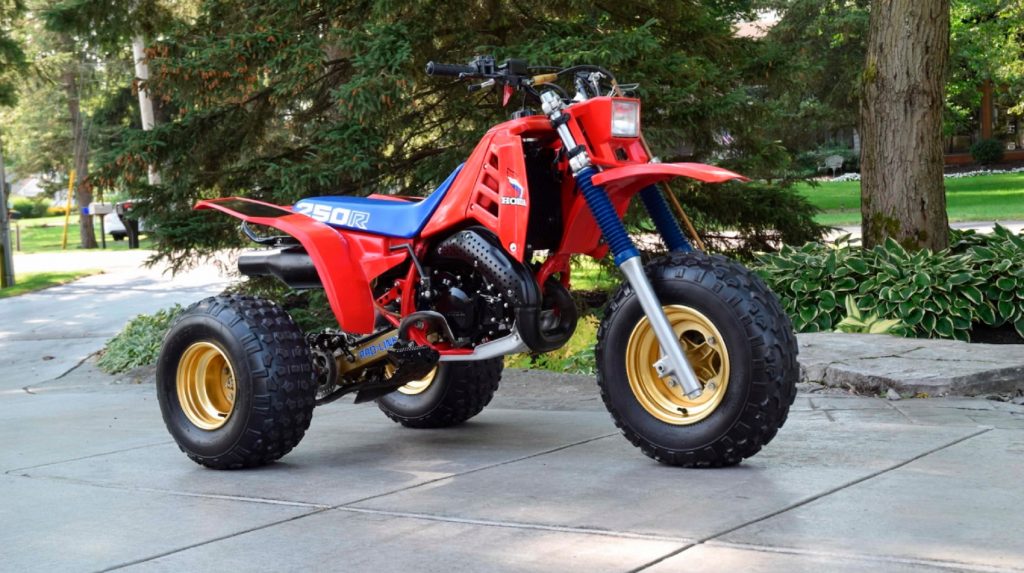
Honda released larger- and smaller-capacity ATC models over the years. But arguably the best-remembered is the Honda ATC 250R first released in 1981. Unlike the other trikes, the 250R has a two-stroke single-cylinder engine and full suspension, Silodrome reports. Plus, both a forepart disc and a rear drum restriction. In 1982 that rear drum was replaced by a disc, and the 1983-1984 models have more than suspension travel and better brakes. And the 1985-1986 ATC 250Rs have more travel, stronger frames, a six-speed manual, and a liquid-cooled engine.
3-wheeled ATVs similar the Honda ATC take several inherent flaws, though
At first glance, iii-wheeled ATVs such as the Honda ATC models had a lot going for them. They were relatively cheap, unproblematic, and significantly easier to residuum on than dirt bikes. Perhaps too easy, though, equally FortNine explains in the video (spicy language alert) below.
RELATED: Tin You Become a Recumbent Trike as an E-Bike?
Trikes are more stable at balance than motorcycles, but at speed, the ATC's layout posed several problems. Firstly, information technology has a rear-heavy weight distribution. Then, if you become off-roading, it can tip backward on anything more than a minor slope. And if you leap it improperly, that heavy rear stop tin can come down on your head.
Secondly, its singular front wheel makes it a 'delta trike,' Laidback Cycles explains; a three-wheeled vehicle similar the Polaris Slingshot is a 'tadpole trike.' While delta trikes aren't unstable per se, their layout makes them more susceptible to turnovers than tadpole trikes, RQ Riley explains. And given that the ATC 250R was basically a racing trike, riders weren't really taking it slow.
RELATED: The Piaggio Ape Is a 3-Wheeled Vespa Mini Truck
To be off-white, as FortNine and DriveTribe explicate, a skilled rider can counter-act a iii-wheeled ATV'south handling quirks. That's done by shifting their body and bodyweight effectually. Withal, this presents some other issue: most Honda ATC riders weren't that skilled. In fact, many of them were children. They could reach the controls just weren't tall plenty to put their feet on the ground. Not to mention lightweight compared to the ATV.
Combine that with slippery pegs that dropped legs into wheels and a high middle of gravity, and you get accidents. Also fatalities and, in some cases, amputations, FindLaw reports. And even in one case y'all factored out skill-level and age, the Consumer Product Commission establish that 3-wheeled ATVs were 2.5-3 times as risky every bit four-wheeled ones, Hemmings reports.
Used classic models are still around
Equally a effect of mounting injuries and deaths, a terminate-auction order meant 3-wheeled ATVs were pulled from the market place in 1988. While trikes are still available, ATVs stick to the quad formation.
RELATED: The Kawasaki KLR650 Is Back To Explore Once More than
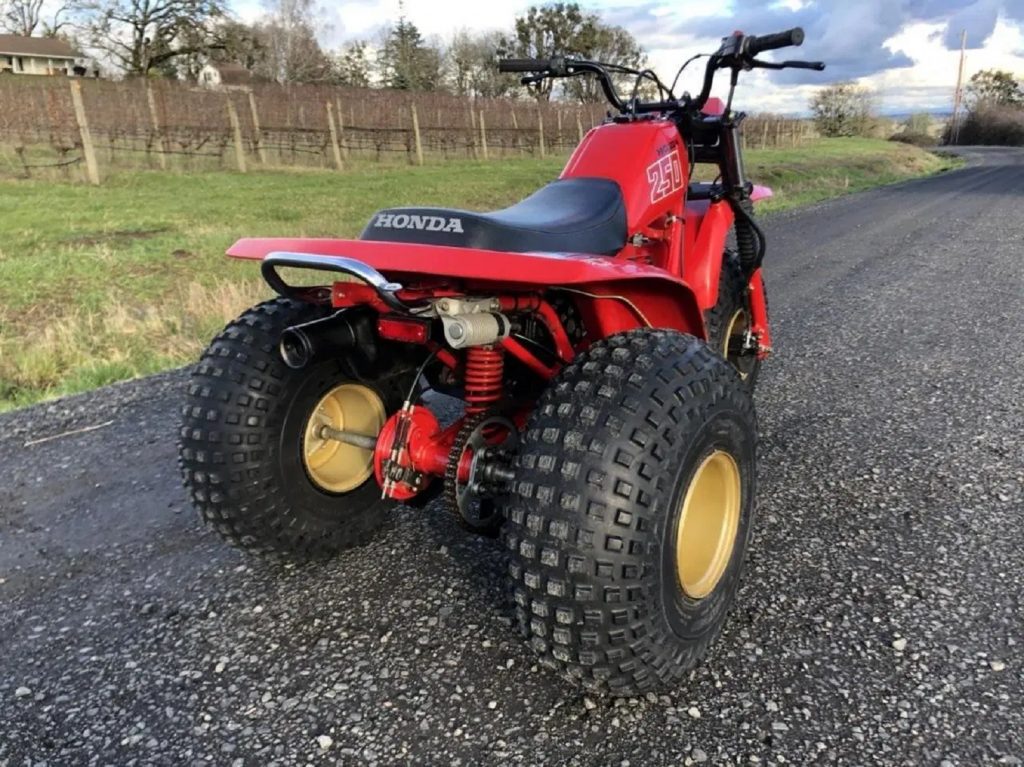
However, while Honda didn't make more ATCs, the classic ones are nevertheless around. And they're adequately affordable, though the 250Rs command a premium. You can pick upwards a basic ATC for $2000-$4000 on Bring a Trailer. And as for the 250R, a 1981 example sold on BaT for $6500 before in February 2021. Plus, some companies even make upgraded racing parts for the ATC.
Merely be enlightened of the potential dangers—and don't put your child on one.
Follow more updates from MotorBiscuit on our Facebook page.
Source: https://www.motorbiscuit.com/theres-a-very-good-reason-you-dont-see-3-wheeled-atvs-anymore/
0 Response to "Arw Atv Companies Going to Start Making Atcs Again"
Post a Comment